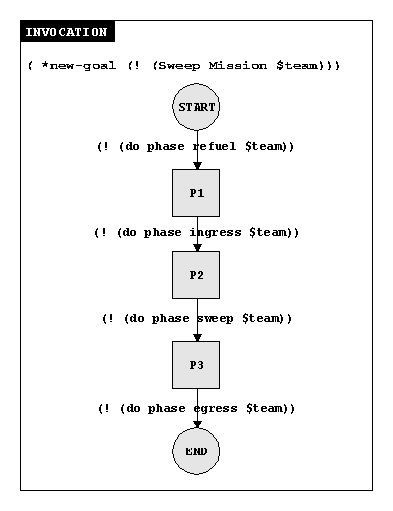
Figure 1. A Sample Mission Plan
Abstract
Research and analysis of military operations using mathematical modelling requires a diverse blend of technologies ranging from vehicle performance and physical environment modelling, software engineering, simulation techniques and OR techniques, all of which must be tailored to achieve the required research outcomes.Additionally military operational analysis requires researchers to have doctrinal and tactical knowledge of military operations in order to represent the tactical decision-making in assessing overall weapon systems performance.
This paper describes the application of SWARMM to analysis of complex tactical behaviour, in the domain of fighter air defence. SWARMM includes tactical reasoning software based on artificial intelligence, together with a convincing representation of physical systems. It is a powerful tool and research vehicle for the study of modern weapon system performance, including critical human decision-making.
The SWARMM model is being employed by AOD (DSTO, Department of Defence) in Defence studies of optimum fighter tactics, including evaluation of possible systems upgrades. SWARMM is now the preferred model in Air Operations Division for operational analysis studies from engagement to mission level. The paper will present a brief overview of SWARMM, the analytical techniques used and issues addressed, and some representative examples illustrating the advantages offered to the analyst in terms of speed and credibility for Defence customers.
When studies are significantly influenced by the operational and tactical behaviour of the vehicle crews, it is clearly important to model these aspects with some fidelity and clarity. Hindsight shows that the modelling of the military doctrine and tactics presents significant challenges. These challenges arise due to the software design difficulties of modelling the tactics adequately and the associated development and testing timescales.
Recognition of the barriers to developing models and conducting studies efficiently led to a new approach employing software-agents featuring the Beliefs-Desires-Intentions (BDI) paradigm. An example of the use of this new paradigm is the SWARMM model.
The fundamental difference between SWARMM and most other simulations of air-combat is the separation of the models of the physical systems from the models of human decision making [MHA+96]. By implementing SWARMM in this way it was possible to take advantage of advances in agent oriented (AO) technologies. SWARMM is a model which has been developed to allow for an improved capability in modeling the tactical decision making aspects of air-combat. It incorporates an existing high-fidelity model of aircraft physical systems with a new agent-oriented approach to modeling human reasoning. The language chosen for the human reasoning modeling is dMARS1. A brief description of dMARS follows in section 2.2 with a more formal and detailed view available in [d'IKL+97].
The use of different plan libraries in SWARMM offers great flexibility by enabling scenarios with numbers of aircraft ranging from 1 vs. 1 to many vs. many, with differing aircraft roles and missions, to be easily constructed and run using the same physical model. The level of tactics included in the plan library may range from very simple behaviour to extremely complex interactions between aircraft in the same team or on the same side.
The ease and simplicity of creating scenarios and modifying behaviour translates directly to improved turn around time on tasks. The graphical nature of dMARS plans is beneficial to the analyst and to the customer, especially when displaying the nature of the tactical simulations to the latter.
Furthermore, within the course of any given study, the tactics used may change from the tactics originally agreed with the customer. For example, naive employment of a particular tactic may result in a change in the measures of effectiveness that is unrealistic. The modification of existing tactics and addition of new ones; means that version control may be problematic.
SWARMM features clear developmental benefits over traditional approaches employing conventional scientific languages such as FORTRAN and C. Apart from the ease of creating and modifying plans in the dMARS language, it is also a simple matter to reconfigure an agent's behaviour by including or deleting plans in its plan library. These plan libraries represent the agent's tactical reasoning capacity and their modularity and reconfigurability facilitate version control and segregation of model behaviour for specific requirements.
Prior to any analyses being conducted, it is necessary to generate the desired tactical behaviour, typically this is an iterative process, in this process the customer should be consulted for feedback.
SWARMM's use of dMARS endows a distinct advantage over traditional languages when displaying and discussing tactical code with the customers. The use of dMARS and the software design, which employs military terminology in the plans and initialisation files, combine to facilitate customer orientation with the study and the important tactical modelling.
The ability to inspect the tactical reasoning structure and execution of the model, via the DCI graphical interface, endows SWARMM with distinct advantages over traditional models. Feedback from the customer is also achieved efficiently via the DCI, as rapid changes to the reasoning can be incorporated as required.
SWARMM analysts work closely with the client at the outset to determine the correct mix of tactical and physical performance required, although the analyst's domain experience is used to determine the optimum means of addressing the study scope with SWARMM. In the case of simple studies, such as tactical defence options against missiles, the analyst will progress from a simple brief.
Once tactical simulation requirements have been scoped, the next step is to determine if existing dMARS tactical plans are adequate, modifications to existing plans will suffice or if new plans may be required. It is in this area that relatively rapid development is possible and where SWARMM excels.
A relational database has been developed which permits clear appraisal of the existing tactical libraries, including the querying of the database by plan keywords, or by tactical phrases. Use of the database clearly facilitates the planning stage of the study, including rapid determination of the tactical plan infrastructure required.
A "study" that requires more than one version of the executable code (eg. two versions of a physical model) may be considered as two separate but related studies.
The plans required for SWARMM fall into two categories. Firstly, there are those associated with the framework of SWARMM - the passing of messages between the reasoning model and the physical model, the deliberation about new information and so on - which are required for the proper functioning of SWARMM and are study independent. Secondly, there are the tactical plans detailing what actions to perform in a particular situation, these are highly study dependent.
The plan database is accessed to determine what plans from previous studies are appropriate for the study under consideration. The "framework" plans are usually taken as a whole from a previous study as they are study independent. The tactical plans from previous studies are examined to assist in designing the plans for this study but in general are not recycled.
The physical models used within SWARMM are usually study independent and can be carried over from a previous study. For example, the model of a missile is the same regardless of the study in question (unless, of course, the study examines the changes in operational effectiveness due to modification of the missile).
The variations that are required for a study involve changes to the data input into a physical model, for example, the number or type of missiles carried. For each study "case" a directory is created with the appropriate input data and a link to the SWARMM executable. The measures of effectiveness (MoE) also introduce specific post-processing requirements on SWARMM and may require appropriate changes to model output data.
Other variations may include the randomised initial directions of radar search beams, of infra-red flare velocity disturbances, and of countermeasure effectiveness evaluations. All of these pseudo-random variations are inherent to the physical model and required for Monte Carlo statistical analysis, however the analyst may wish to concentrate upon certain aspects for a given study, by modifying the basic behaviour.
Whilst a number of physical models used within SWARMM incorporate random effects, the radar model in particular uses a random number generated to model the randomness associated with radar detection. The seed value used to start the random number generator can be explicitly specified or selected based on the time of execution.
SWARMM is a deterministic model where the model output for a specific case can be regenerated by specifying the seed for the random number generator and the input data for that case. Any perturbations in platform initial geometry are controlled by the random seed.
Study results are obtained by executing the SWARMM model a large number of times.
Each of the manoeuvres to be evaluated requires a new plan or set of plans to be written which will replace or override the standard missile evasion manoeuvres in the target aircraft's plan library. In addition, plans may need to be written or modified in order to ensure that the target reacts to the missile launch at the appropriate time and begins the evasion manoeuvre in the appropriate way. In order to evaluate each manoeuvre separately, each manoeuvre type becomes a separate scenario.
As stated previously, the physical model contains pseudo-random variations that influence radar detection of the target as well as the targets observation of a possible missile firing, whilst the starting positions of the aircraft are also randomly perturbed to counter the possible influence that the initial positions of the aircraft may have upon the simulation results. A large number of runs may then be carried out and Monte Carlo statistical analysis performed (see section 5.3.1).
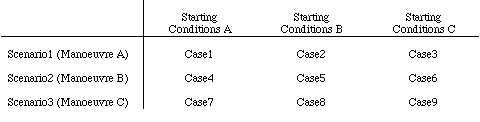
A range of starting conditions for each scenario are considered, Table 1: these are used to examine the sensitivity of the manoeuvre effectiveness to changing the parameters defining one or more of the manoeuvres. This would result in a further set of cases to be investigated and an expansion in the table.
As an example, for any target/launcher geometry there is a corresponding maximum range, Rmax, at which the missile is able to intercept a non manoeuvring target. As the launch ranges reduces from Rmax the missile is increasingly able to intercept a target that is manoeuvring. Therefore, the percentage of Rmax at which the missile is launched influences the effectiveness of any evasion manoeuvre carried out by the target. A sensitivity analysis of the launch range upon manoeuvre effectiveness may be carried out by varying the percentage of Rmax at which the launch aircraft is allowed to fire its missile. This further expands the number of cases to be considered and, as more parameters are added to those to be analysed, the number of cases to be investigated rapidly becomes excessive.
It may therefore be necessary to perform a mini-study to evaluate the sensitivity of the manoeuvre effectiveness due to a change in selected parameter values. A decision as to what parameters are likely to have greatest influence upon the results may then be made to limit the set of cases to be investigated. A more comprehensive study of the reduced set of cases may then be carried out.
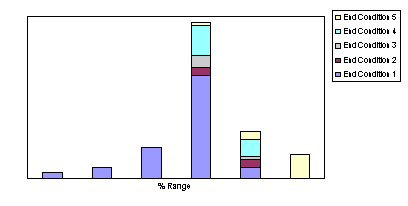
Post-run processing of output from Monte Carlo runs may be carried out using the tool studProcess [Smi97]. Using studProcess it is possible to correlate various parameters output to file by SWARMM and create histograms of those parameters. For example, there are a variety of conditions that will prevent a missile from successfully intercepting a target and these are output to file [Tur97]. It is therefore a simple matter to post process results obtained from a large number of Monte Carlo runs and collate the missile failure reasons against parameters such as range at launch, target delay in reacting to missile launch, etc (see Figure 2). This will enable the analyst to determine the effect of such parameters upon the success of the evasion manoeuvre.
However, to explain why any manoeuvre was or was not successful it may be necessary to examine one or more representative runs in more detail. For this example, missile performance parameter time histories may be post processed for any aircraft in an individual run. These time histories may then be used in conjunction with run-time visualisation tools to gain an insight into the effect the manoeuvre has upon the missile guidance system.
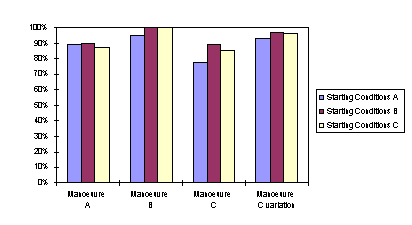
An example of operationally focussed client reporting is shown Figure 3 where tactics are simply presented in terms of relative effectiveness and tactical issues affecting the results would be described in appropriate terms.
For studies which have been tasked by other areas of Defence, the reporting style will be closer to the nature of a scientific report. There will be more justification of study cases, the procedures adopted on starting conditions, the scope of the study and necessary assumptions. All of the above are, of course, relevant to the operational unit, however it may be sufficient to use some pointers to these, in the knowledge that a mutual understanding must exist at the working level.
SWARMM is now a mature system in everyday use within DSTO for the study of military OR issues. By fostering close interactions with operational squadrons and by selecting technologies which allow for rapid response and ease of transfer of information AOD are able to answer complex analytical problems in a timely and relevant manner. In the rapidly changing and increasingly more complex world of modern military systems there is a need for modelling and simulation to stay at the leading edge of technology growth. SWARMM is a leading edge example of modern OR techniques which can be employed to address effectiveness studies in the highly complex military environment.
SWARMM emphasises the importance of the human operator as a part of the total system and allows for the incorporation of human factors issues such as workload, stress, and skill-level into the evaluation of tactics and hardware.
Experience to date has demonstrated the advantages of employing BDI agent technology for tactical behaviour modelling, with traditional mathematical models of physical systems and the environment. The combined dMARS/physical system approach has proven advantages over traditional equivalent models during model design and coding, development testing, separation of study variations, and study execution and post-processing. These advantages magnify when the complexity and scope of tactical modelling increase with the scale of the required study.
Future developments of SWARMM will be extended to include greater representation of human performance in the agents, and applied at the campaign as well as the engagement and mission levels.
REFERENCES:
| [Bra87] | M. Bratman. Intentions, Plans, and Practical Reason. Harvard University Press, Cambridge MA, 1987 | |
| [d'IKL+97] | M. d'Inverno, D. Kinny, M. Luck, and M. Wooldridge. A Formal Specification of dMARS. In Pre-Proceedings of the Fourth International Workshop on Theories, Architectures and Languages, 1997. | |
| [GL86] | M. Georgeff and A. Lansky. Procedural Knowledge. In Proceedings of the IEEE Special Issue on Knowledge Representation, volume 74, pages 1383-1398, 1986. | |
| [Llo97] | I. Lloyd. Simulating Human Characteristics for Operational Studies. DSTO Research Report DSTO-RR-0098, 1997. | |
| [MHA+96] | D. McIlroy and C. Heinze, Air Combat Tactics Implementation in the Smart Whole Air Mission Model (SWARMM). In Proceedings of the First International SimTecT Conference, Melbourne Australia, March 1996. | |
| [MHA+97] | D. McIlroy, C. Heinze, D. Appla, P. Busetta, G. Tidhar and A. Rao. Towards Credible Computer-Generated Forces. In Proceedings of The Simulation Technology and Training Conference (SimTecT), Canberra, Australia, March 1997. | |
| [Pap97] | M. Papasimeon. The Xcombat Users Guide. Air Operations Division working paper, unclassified, 1997. | |
| [RG91] | A. Rao and M. Georgeff. Modeling rational agents with a BDI architecture. In J. Allen, R. Fikes, and E. Sandewall, editors, Proceedings of the Second International Conference on Principles of Knowledge Representation and Reasoning., pages 473-484. Morgan Kaufmann Publishers, San Mateo, CA, 1991. | |
| [Smi97] | B. Smith. Post-Processing Software for PACAUS and SWARMM. Air Operations Division working paper, unclassified, 1997. | |
| [THS97] | G. Tidhar, C. Heinze, and M. Selvestrel. Flying Together: Modeling Air-Mission Teams. In preparation. To be published in Apllied Intelligence , Kluwer Academic Publishers, Boston, 1997. | |
| [Tur97] | M. Turner, PACAUS/SWARMM: Missile Model Success/Failure Flag Meanings. Air Operations Division working paper, unclassified, 1997. |